Your Community Doesn’t Care… and that’s a good thing


Equal Representation Isn’t User-Centered Design
Everyone wants charts that go up and to the right.
More page views. More “engagement.” More eyeballs lingering just a little bit longer on every page. But in my experience working on UX in government, the moment content authors let go of that obsession with “equal representation,” things almost always get better for their community.
People suddenly find what they came for. Even the weird niche stuff stays discoverable. And nobody has to think about “Wastewater” unless something has gone very, very wrong.
Because in this case, when the community does care about wastewater, it usually means their toilet’s backing up, not that your IA is a work of genius.
Underneath all of this is a bigger, more uncomfortable truth: the real problem isn’t that we’re “hiding” content. It’s that an organization’s structure and its users’ needs almost never line up neatly—and when they don’t, your information architecture inherits the dysfunction.
The Problem: When IA Mirrors the Org Chart
We recently reworked the web presence for the City of Bend’s Water Services Department. On paper, they had five divisions:
Billing
Water Quality
Water Conservation
Stormwater
Wastewater
Each division wanted equal love on the department landing page.
On the surface, that feels fair. Every division serves the public. Every division wants to be seen. Nobody wants to be the neglected middle child shoved into a footer link.
But when I pulled traffic data from July 2024 through June 2025, reality didn’t exactly care about feelings:
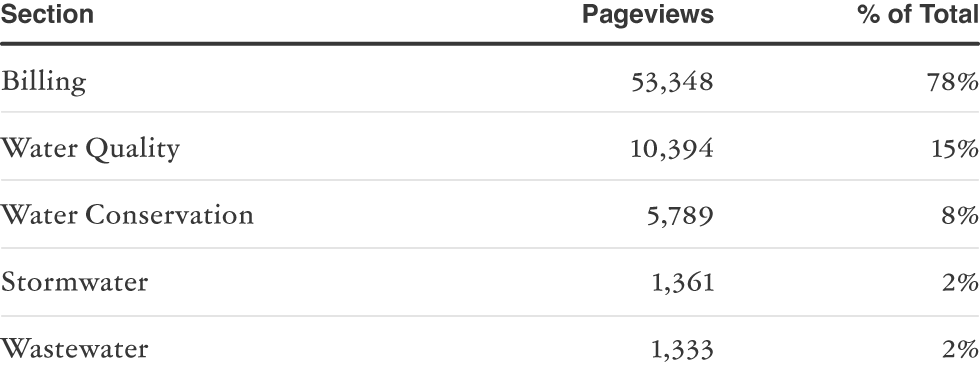
And here’s the kicker: the department landing page itself got only 4,838 pageviews—less than a tenth of what Billing pulled on its own.
The old IA did what a lot of government sites do: it treated the org chart like a sitemap. All five divisions were presented as equally important text links—front and center on the landing page (and again in the side menu, but that’s another story).
Users weren’t confused about whether the divisions existed. They were confused about which one they needed.
So they did what people always do online: they routed around the problem. They skipped the landing page entirely and went straight to Billing, because 78% of them just wanted to pay their bill and get on with their day.
This wasn’t a search engine problem. This was an information architecture problem. Users had already voted with their clicks. The IA just hadn’t caught up.
Why Equal Representation Feels Right (But Isn’t User-Centered)
This is where psychology sneaks in.
When we design from the inside of an organization, we almost reflexively default to equal representation. It feels democratic. It keeps the politics quiet. Everyone gets their box on the homepage, so everyone feels respected.
But user-centered design isn’t about treating all content equally. It’s about treating all users with respect.
And users don’t arrive thinking, “I wonder how this department is structured.” They arrive thinking, “My bill is due in 7 minutes, and I’ve already had a day!”
When we hit them with a wall of equally-weighted choices, we’re not “giving them options,” we’re handing them a small cognitive tax form.
Psych folks would call this decision fatigue or cognitive load. The gist is: every unnecessary decision you force on someone—especially one that feels arbitrary—uses up mental energy they didn’t want to spend. High cognitive load can drop engagement significantly and drive up task abandonment. People don’t remember your carefully balanced menu of options.
They remember being annoyed.
In the Water Services example, the IA was effectively saying:
“Here are five equally important things. Pick one.”
But that wasn’t the user’s mental model. To most people, those other divisions weren’t “equally important,” they were noise. The vast majority of visitors had one job: pay the water bill. The equal representation of the other divisions didn’t make anyone feel seen; it just slowed everyone down.
And the cost here isn’t just “lost page views.” It’s lost trust.
People who couldn’t find what they needed left frustrated.
People who did find it had to work harder than they should have.
People who needed niche information—like water quality reports—had to wade through irrelevant options first.
All because the IA was optimized for how the department felt about itself, not for how residents actually thought about water services.
The Fix: Let User Behavior Drive Your IA
So we did something that felt slightly heretical but was entirely obvious in the data.
We took what had been the Billing landing page and made that the department landing page.
The old department landing page didn’t vanish; it got demoted (or, more accurately, clarified) into an “About the Department” page.
This wasn’t a campaign to erase the other divisions. It was an acknowledgment of reality:
When 78% of your users are coming for one thing, that thing should be the front door.
The other divisions are still there: still accessible, still maintained, still searchable. They’re just not in a popularity contest they were never going to win.
If you want to pay your bill, you land exactly where you need to be.
If you’re interested in water conservation or stormwater, you can still find it—with fewer irrelevant choices getting in the way.
The principle isn’t “hide content.” It’s: stop pretending your org chart is your user’s mental model.
And this goes way beyond government.
Any organization with multiple departments, product lines, or content areas runs into this tension. Are you structuring your IA around what makes sense internally, or what’s actually happening in your analytics and user research?
The Stakeholder Moment
Of course, the moment you propose something like this, the org antibodies come out.
When we first walked through this restructuring, division managers were understandably nervous. They worried about “losing visibility.” They wanted reassurance that their content would still be “easy to find.”
They weren’t wrong to care. But their definition of “easy to find” was anchored to organizational representation, not to user behavior.
So we got everyone in a room.
We walked through:
The sitemap
Page-level IA decisions
The traffic data
How each choice tied back to what residents were actually doing
We also zoomed out and talked about the department—and the City as a whole—as a single system instead of five separate silos competing for homepage real estate.
Once people saw the data and the logic behind the structure, the temperature in the room dropped. Resistance didn’t just soften; it mostly evaporated.
The lesson for me was crystal clear:
Being transparent about how you made a decision builds more buy-in than spending all your energy defending that you made it.
From then on, we made this the default pattern: meet with all division managers at the start of any project. Talk through:
Pain points
Wish lists
The process we’ll use to make tradeoffs
It’s slower upfront. But it saves you from the miserable, late-stage “Why did you move my cheese?” conversation later.
Measuring What Actually Matters
This is where a lot of organizations sabotage themselves.
They track page views and engagement, then wonder why those numbers don’t map to user satisfaction.
Page views are a vanity metric. They tell you how many times someone clicked, not whether their problem was solved.
If a resident clicks through five pages hunting for a form and then gives up, you get five page views and zero value—for you and for them.
Better questions to ask:
Task completion rate: Did people actually find what they came for?
Time-to-resolution: How quickly could they get an answer or complete a task?
User satisfaction: Would they come back? Would they recommend this to someone else?
For the Water Services Department, the real win isn’t “more traffic to the landing page.” It’s:
Fewer clicks to pay a bill
Fewer frustrated calls to staff
Higher task completion across the board
We’re launching the new site at the end of January 2026, and I’ll be watching those metrics closely. But honestly, the core principle is already battle-tested:
When you stop forcing people to wade through irrelevant options—and lead with what they actually need—you reduce cognitive load and dramatically improve the experience.
The Broader Lesson
When you let go of “equal organizational representation” and instead design around user mental models, everyone actually wins—including the folks who were worried about disappearing.
The Water Conservation team still attracts people who genuinely need that information.
The Water Quality team still serves its audience.
And community members trying to pay their water bill don’t have to think about “Wastewater” at all—unless, again, something’s gone horribly wrong.
This is true whether you’re a city, a SaaS company, a university, or a hospital system:
Your org chart is not your user’s worldview. Your internal structure is not how people think about your services.
So the next time you’re redesigning an IA, try asking:
Are we organizing this around how we’re structured, or how our users actually behave?
If the answer is the former, there’s a good chance you’re introducing friction you can’t see yet—but your users feel it every time they land on your site.
And they don’t care about your structure. They just want to get in, get what they need, and get on with their lives.
Which, when you think about it, is kind of the point.
-jr.